Showing posts with label Le Nozze di Figaro. Show all posts

Monday, December 28, 2020

WW84 Confusingly Uses Mozart For Emotional Affect

Remember coloratura soprano Christine Johnston? Well, she's resurfaced in the second full-length feature Wonder Woman film titled WW84. Unfortunately it's not flattering for anyone. For some reason the producers decided to use the aria "Voi che sapete" from Mozart's Le Nozze di Figaro in what is supposed to be a fantastical scene of discovery as Steve Trevor (Chris Pine) sees the technology in the world of 1984 that he's been thrust into after being resurrected from 1918. Much of this film reads as a cheesy B-movie from the '80s, but this was a real lost opportunity. In the context of the opera, the character of Cherubino is Count Almaviva's page and a teenage boy who is girl-crazy. In opera this is known as "pants role" and sung often times in modern day by a mezzo-soprano. For this aria, we find out that the Count is tired of Cherubino's philandering with women so he's sending him off to army duty in Seville. Cherubino sings to Countess Almaviva and the servant Susanna about how much love he has to give. Hijinks ensue as any good as any plans that Beaumarchais created in his play La Folle Journée, ou Le Mariage de Figaro on which Da Ponte based his libretto. The opera premiered in 1786, so maybe there is supposed to be some cleverness about the '80s? The film score was hammered out by Hollywood veteran Hans Zimmer so maybe this was his idea? At any rate, the audience has to endure a pedantically sung piece that has no place in this movie. You can watch the film on HBOMax: https://www.hbomax.com/wonder-woman-1984. After the jump is a performance of "Voi che sapete" by Frederica von Stade.


Wednesday, August 12, 2015

"Mission: Impossible" Gets The (Vienna State) Opera Treatment

Soprano Lise Lindstrom has sung the title role of Puccini's Turandot at the Metropolitan Opera, Teatro alla Scala, Royal Opera House Covent Garden, Les Choregies d'Orange, and many other opera companies around the world. (Photo: Lisa-Marie Mazzucco)
Critic Alex Ross brilliantly covers the classical music-infused sequences of the new Tom Cruise thriller Mission: Impossible - Rogue Nation. From opening scenes featuring Mozart's Le Nozze di Figaro overture to extended excerpts of Puccini's Turandot. Although actors portray the opera roles of Turandot (America Olivo) and Caláf (Jesus Alvarez), the parts are sung here by Lise Lindstrom and Gregory Kunde under conductor Philippe Auguin (played by Nicholas Lupu in the film). Most of the action takes place at the Vienna State Opera. There's even a splash of Beethoven's Eroica Symphony thrown in for classical good measure. And it is probably no coincidence that the femme fatale of the film, played by Rebecca Ferguson, is named Ilsa Faust. Hélas, no Gounod is found in the film. Read the entire review by clicking here. Watch a clip of Lise Lindstrom singing the role of Turandot, after the jump.
Tom Cruise as the indestructible Ethan Hunt in Mission: Impossible - Rogue Nation.

Thursday, September 25, 2014

Vogue Covers Opera Fashions On MET's Opening Night "Figaro"

Pre-Nozze: Anna Netrebko and soon-to-be-husband Yusif Eyvazov at opening night festivities.
Vogue photographer Hannah Thomson was at the Metropolitan Opera's Opening Night Gala. The evening featured a performance of Mozart's Le Nozze di Figaro. Evening attendants included Maggie Grace, Zac Posen, Vera Wang, Grace Coddington, Josh Lucas, Christine Baranski, and more. See the full gallery of the glamorous night by clicking here
Fall Fashions: Mercedes Bass and soprano Renée Fleming

Tuesday, September 2, 2014

"Zombieland" Rule #32: Genießen Sie die kleinen Dinge

"A shy student trying to reach his family in Ohio, and a gun-toting tough guy trying to find the Last Twinkie and a pair of sisters trying to get to an amusement park join forces to travel across a zombie-filled America." The 2009 cult classic film Zombieland, from director Ruben Fleischer, features a scene where actors Jesse Eisenberg, Emma Stone, Woody Harrelson, Abigail Breslin, tear up a souvenir shop while the overture from Mozart's Le Nozze di Figaro serves as the soundtrack to the scene. As the destruction is complete, the phrase "Rule #32: Enjoy the little things" pops above the screen. Watch the clip from the movie, as well as the complete overture, after the jump. [Source]

Wednesday, June 4, 2014

Silvana Dussmann: A Study In Dramatic Soprano Vocal Prowess

Born in Vienna, soprano Silvana Dussmann was destined to perform the German repertoire of Mozart and Strauss. After studying with Rita Streich and Gerhard Kahry, she won first prize for operetta at the Vienna Belvedere Competition in 1987. Her debut was as Lisa in Franz Lehár's Das Land des Lächelns at the Volksoper Wien opposite Nicolai Gedda. She soon became an ensemble member of the Tiroler Landestheater Innsbruck, where she sang
roles such as Ilia (Idomeneo), Konstanze (Die Entführung aus dem Serail), Pamina (Die Zauberflöte), Micaëla (Carmen), Laura (Der Bettelstudent), and Rosalinde (Die Fledermaus). Subsequently in 1990 she debuted in the title role of Emmerich Kálmán's Die Csárdásfürstin at the Seefestspielen Mörbisch. By 1992 she was engaged by Opernhaus Graz where she extended her repertoire to roles like Violetta (La Traviata), Sophie (Der Rosenkavalier), Agathe (Der Freischütz), and Angèle Didier (Der Graf von Luxemburg). Beginning in 1994, Ms. Dussmann began performing at the Wiener Volksoper as Musetta (La bohème), Marchesa del Poggio (Un Giorno di Regno), Frau Fluth (Die lustigen Weiber von Windsor), Vitellia (La Clemenza di Tito), Donna Anna (Don Giovanni), Countess Almaviva (Le Nozze di Figaro), and the title role in Norma. In 1996 she was reviving her portrayals of Musetta and Rosalinde for the Wiener Staatsoper. She went on to perform at the Aalto-Musiktheater in Essen, the Bayerischen Staatsoper in München, Israel Philharmonic in Tel Aviv, and Opera Bonn. At Wiener Festwochen in

Monday, December 30, 2013

Fun Insider Secret Onstage At The Metropolitan Opera

(Photo: Jonathan Tichler/MET Opera)
"Another small insider homage could be found on the stage of the Metropolitan Opera this month, in its lavish production of Der Rosenkavalier, by Richard Strauss. In the third act, after the boorish Baron Ochs’s attempted assignation at a tavern goes disastrously and hilariously wrong, he is besieged with bills from the innkeeper and a host of others. Invisible to the audience — whether sitting in the back of the Family Circle or the front of the orchestra — is what the long paper bills thrust at him actually say. In flowing cursive writing, the bills list the cast from the current production’s 1969 premiere, starting with the conductor, Karl Böhm, and naming everyone from Leonie Rysanek, who sang the Marschallin, to Christa Ludwig, who sang Octavian, to Charles Anthony, who was the innkeeper that night (and who sang some 2,928 mostly small roles at the Met during his long career). The tradition of these kinds of in jokes goes back centuries. Mozart’s Don Giovanni has an allusion in the last act to his own Le Nozze di Figaro." [Source]

Tuesday, May 15, 2012

Daphne Guinness Discusses Her Love (and Hate) of Opera

PETER BRANT II: I’m musically challenged. I love music, but I can’t play . . . When I was little, I wanted to be a child prodigy, but I was awful at the piano.
DAPHNE GUINNESS: I had an accident with my right hand, so I stopped playing. It had to do with a lawn mower. Can you imagine? I’ve still got scars. I’m almost ambidextrous as well. So I’ve always had this kind of left hand-right hand problem anyway, but my writing on this hand is almost calligraphical now. I don’t know why, because I didn’t ever learn it. My hands kind of work separately. But singing was always very, very, very easy for me. I know in the last few months it doesn’t look like I’m afraid of putting myself out there, but I also have terrible nerves. I don’t think I’m going to be performing any time soon, but I might join a choir.
PETER BRANT II: Really?
DAPHNE GUINNESS: Yeah. It would be kind of fun. I always wanted to join the choir up in Harlem. They really know how to sing! That’s really great. I like certain operas. I’m not very keen on Puccini. If I have to see another La Bohème, I’m going to shoot myself. I mean, really. There are certain ones I love like the Ring [cycle], and I love Tristan und Isolde. I love Parsifal. I love Il Trovatore. I love all the Mozart operas. The Magic Flute bothers me because I just don’t like it when there’s no recitative. They start talking in the middle. I don’t like musicals for the same reason. Because when someone suddenly bursts into song in the middle of a sentence, you just think, That’s weird. But I like it when the whole thing is sung.
PETER BRANT II: I love The Marriage of Figaro.
DAPHNE GUINNESS: I can sing that from beginning to end And the Overture . . .

After the jump, an excerpt of Ms. Guinness singing "L'ho perduta, me meschina" from Mozart's Le nozze di Figaro[Source]

Monday, February 6, 2012

Benedict Andrews Moves "Figaro" to a Gated Community

Joshua Bloom, Benedict Andrews, and Taryn Fiebig, at the Sydney Opera House
(Photo: Nikki Short/The Australian)
"Oxygen masks, walking frames and maids in starched uniforms are not normally associated with Mozart's 18th-century opera The Marriage of Figaro. But in director Benedict Andrews's imagination, these touches are a way to bring European feudal society crashing through the centuries into modern times. One of Australia's most accomplished theatre makers, Andrews is staging his first opera here after a false start two years ago. His production of Figaro was slated for 2010 but Opera Australia postponed it amid box-office fears and a $900,000 deficit. In the meantime, Andrews made his opera debut with a London production of The Return of Ulysses. 'I'm getting my first big drug hits as an opera addict,' he said before a rehearsal yesterday at the Sydney Opera House. Andrews has transferred Figaro from an 18th-century manor in Seville to a modern gated community to make clear tensions between characters of different social classes. 'This milieu, the framing device of the gated estate, there's nothing that radical about it,' he said. 'It's a simple transposition to a plausible present. 'The opera is about forms of love, forms of desire . . . but they are associated with class and politics and who has what, who gets what, who wants what.' The action begins with a young couple on their wedding day, Figaro and Susanna, and the threat of their aristocratic master, the Count, to exercise the droit du seigneur: the mythical right of a feudal lord to take a subordinate girl's virginity." [Source] For more about performance dates and purchasing ticket prices, click here.

Sunday, January 22, 2012

When Record Companies Lavished Consumers With Luxury

Check out this listing on eBay for a box-set LP recording of Le Nozze di Figaro that comes with complete vocal score to the opera! Once CD production came into being, the consumer was lucky to get liner notes. Now with MP3 format, it seems as though it is better that the public knows as little about the recording or performers as humanly possible. And if you want a libretto while listening to the opera? Well, you'll have to sit at your computer to see it on screen for the duration. Two more pics after the jump.

Monday, November 21, 2011

Musical Film "My Sister Eileen" Contains Opera References

At the opening of the film, the girls are in their first apartment when they hear operatic singing coming through the window. The landlord declares, "Maybe it's the next Lily Pons or Helen Traubel." Cut to the trio exiting the apartment to find a woman hanging up laundry while she sings "Voi che sapete" from Mozart's Le Nozze di Figaro. Full synopis for the film: "Two innocent sisters from Ohio hit Greenwich Village and must cope with wall-shaking subway construction, the neighborhood kooks, and a whopping $65 a month for an apartment. My Sister Eileen is one of those 'Look out, world, we're conquering Manhattan!' movies, with Betty Garrett as a plain, would-be writer and Janet Leigh as her knockout sister, an aspiring actress who draws men like milk draws kittens. The 1955 movie's well-scrubbed Greenwich Village is a delightful fantasy playground. The city was never like this, but it probably should have been. In one of his early roles, Jack Lemmon (crooning one of the Jule Styne-Leo Robin songs quite charmingly) plays a magazine publisher, one of the many Young Men with Ideas he would play in the subsequent decade. Even more interesting is the presence of future director Bob Fosse, as a soda jerk who romances Leigh. Fosse also choreographed the film's musical numbers, and his dances include a delightful quartet at a bandstand and a sensational showdown with Tommy Rall. Fosse and Rall try to outdo each other in a male rivalry dance that will remind Fosse fans of his obsession with hats. The breezy direction is by Richard Quine, who cowrote the script with another future director, Blake Edwards. The original source material, stories by Ruth McKenney, formed the basis for a play and a nonmusical 1942 Rosalind Russell movie, also called My Sister Eileen (in which Quine played the Fosse role); there was a Broadway musical adaptation of the stories, Wonderful Town, which is not related to this film." [Source]

Friday, November 4, 2011

David Pittsinger is Willing to Take the Risk on Every Performance

Pittsinger as Almaviva
(Photo: Cory Weaver/Portland Opera)
Bass-baritone David Pittsinger is currently singing the role of Count Almaviva in the Portland Opera production of Mozart's Le Nozze di Figaro. He gives an interview to David Stabler of The Oregonian in which he reveals how Broadway performances have helped him in opera: "Pittsinger, 48, lives in Connecticut with his wife and twin son and daughter. He has sung innumerable counts, as well as Figaros, but he's also a cross-singer to Broadway, having sung Emil de Becque in Lincoln Center Theater's celebrated revival of South Pacific, and in Portland on a national tour of the show last year. He loves Broadway's challenges, which are different from opera's, beginning with singing eight shows a week. Talk about risk: Last year, he pulled off something no other singer had done. On a Saturday afternoon, he sang de Becque in the Vivian Beaumont Theater, then walked next door to the Metropolitan Opera, where,
David as Emil de Becque in
Lincoln Center's South Pacific.
that night, he sang the role of the ghost in Hamlet. It was believed to be the first time a performer starred in a Broadway show and an opera in the same day, according to The New York Times. 'I can't begin to explain the honor and gratitude for being on two stages in one day,' he says. A comment from stage director Tito Capobianco helped. Capobianco worked with Pittsinger at Yale University and also has worked frequently with singers in Portland State University's opera program. Manage your fear, the director told him. 'If you fear the fear, it will be more the rule than the exception.' Before adding Broadway roles, Pittsinger used to hold back, vocally, to protect his voice. 'I never saved my voice in South Pacific. I invested everything every time onstage. I didn't feel like I was lying anymore. I became a truthful actor.' Another comment, from Tony-winning choreographer Tommy Tune, gave him more perspective. 'We live for long runs because every night, you have another chance to take another chance.'" [Source]
Family man: David Pittsinger with wife, soprano Patricia Schuman, and twins.

Wednesday, February 23, 2011

The Amadeus Effect: How A 1984 Film Succeeds On Many Levels

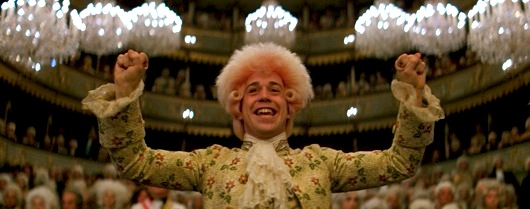
Actor Tom Hulce portraying Wolfgang Amadeus Mozart in what would become the role of a lifetime.

TCM is running Academy Award-winning movies all month long as a lead-up to this year's awards ceremony on February 27. Last night's feature was the 1984 musical bio-pic Amadeus. Written by Peter Shaffer and directed by Miloš Forman, the story is told from the perspective of Antonio Salieri who is delirious with fictionalized jealousy for a contemporary composer named Wolfgang Amadeus Mozart. Perhaps at first glance the project may not have appealed to a high-brow society that puritanically fills concert halls and opera houses but it manages to introduce moviegoers to wonderful Mozart compositions, some for the first time. "Amadeus is a magnificent film, full and tender and funny and charming -- and, at the end, sad and angry, too, because in the character of Salieri it has given us a way to understand not only greatness, but our own lack of it. This movie's fundamental question, I think, is whether we can learn to be grateful for the happiness of others, and that, of course, is a test for sainthood." - Rogert Ebert, film critic. Read more about Mozart, Salieria, the cast of the film, and learn more about the music featured in Amadeus, after the jump.