Previously this blog discussed the importance of musical lineage and the art of carrying on operatic traditions. This transfer occurs with the passing of experience from conductors and composers on to singers through working relationships. But perhaps the most intimate form of sharing comes directly from a voice teacher. Throughout history singers have traditionally worked with teachers who had a good career themselves on the opera stage. The many upsides to such a relationship include a direct connection to the previous generation's style and musical
Pauline Viardot-García
Natalia Iretskaya
Lydia Lipkowska
knowledge that often times could be linked directly to a composer. A current example of this linked artistry begins over 100 years ago with a leading nineteenth-century French mezzo-soprano, pedagogue, and composer of Spanish descent named Pauline Viardot-García. After a long career on stage, she began teaching young singers. One of those pupils was the Russian soprano Natalia Iretskaya, who would in turn passed her vocal pedagogy down to a fellow country woman named Lydia Lipkowska. This Russian soprano had a career that spanned several decades beginning at the Mariinsky Theatre and eventually crossing the ocean to perform quite often in the United States (Boston, Chicago, New York). At the end of her career she began to teach voice lessons in Romania. It was here that she convinced a young singer named Virginia Zeani that she was not a mezzo-soprano, but rather a soprano. Madame Lipkowska coached her in the roles of Violetta, Mimi, Marguerite and Massenet’s Manon. Romanian dramatic-soprano
Virginia Zeani
Marilyn Mims
Virginia Mims
Virginia Zeani is legendary for a career rivaling Maria Callas and is still connected to the spotlight thanks to a close friendship with current diva Angela Gheorghiu. But it was her engagement at Indiana University's music school in 1980 that allowed her to pass on her talents to another generation of sopranos including Sylvia McNair, Angela Brown, Elizabeth Futral, and Ailyn Pérez. One particular student stands out in the history of her teaching: Marilyn Mims. As fifth generation in this line of skilled singing technique, Ms. Mims went on to win the 1986 Metropolitan Opera National Council Auditions. Soon after she made her professional opera debut and began a career filled with roles in La Traviata, Robert le Diable, Die Fledermaus, Die Entführung aus dem Serail, Don Giovanni, Così fan tutte, Rigoletto, Lucia di Lammermoor, Pagliacci and more. Her singing career was cut short after being diagnosed with endometriosis in 1995. She now teaches on the voice faculty at Palm Beach Atlantic University in Florida. And now the world will soon have another soprano to sing the "Viardot-García technique": Virginia Mims. Yes, daughter to Marilyn, this young lady is emerging as a strong talent in several singing competitions. She will be carrying an artistic torch that is steeped in excellence. With more than a century's worth of technique and musical knowledge being passed down from one stupendous soprano after another, this 18-year old is inheritor to a true treasure. Read about all these extraordinary divas, as well as sample audio and video clips, after the jump.
Soprano Virginia Zeani gives a preview to the new limited edition collection of her beloved recordings which goes on sale February 5, 2015. The set will be available through Norbeck, Peters and Ford. View the box set artwork after the jump.
Power Quartet: Tito Capobianco, Leona Mitchell, Virginia Zeani, and Renata Scotto, post-recital in Fort Lauderdale, Florida, on February 22, 2014. Details of the evening are after the jump. (Photo: Venetian Arts Society/Facebook)
The latin term trado has been translated into a multitude of definitions: to hand over, give up, deliver, transmit, surrender, impart, entrust, confide, leave behind, bequeath, propound, propose, teach, to hand down, narrate, recount. It served as the basis for the word we now know in the English language to be tradition. With the recent passing of Magda Olivero (age 104) and Licia Albanese (age 105), the opera world loses yet another link to the composers of the past. These were the last remaining sopranos that originated the 20th-century's verismo period and served as an essential connection to the past for future opera audiences. Once upon a time, singers worked directly with composers to tweak the characterization and often had music written specifically for their vocal capabilities. There was something almost sacred that was being passed down for safekeeping to the following generation. Looking back over the history of slightly more than 200 years reveals a great deal about the relationship with the soprano and composer.
Wolfgang Amadeus Mozart had soprano Caterina Cavalieri. A singing student of rival composer Antonio Salieri, Mozart wrote the role of Konstanze in his Singspiel Die Entführung aus dem Serail for the soprano which she premiered on July 16, 1782. On May 7, 1788, Cavalieri sang the role of Donna Elvira in the Vienna premiere of Mozart's Don Giovanni. Other works by Mozart written for her are Davide penitente (1785) and the role of Mademoiselle Silberklang in Der Schauspieldirektor (1786). Gioachino Rossini had Isabella Colbran. Born in Madrid, she studied under Girolamo Crescenti in Paris. The dramatic coloratura soprano first met Rossini in Naples where he composed the title role of Elisabetta, regina d'Inghilterra especially for her in 1815. She went on to sing the lead roles in his operas Otello, Armida, Mosè in Egitto, Ricciardo e Zoraided, Ermione, La donna del lago, Maometto II, and Zelmira. He eventually married the soprano in 1822 when they moved to Bologna and she sang the last role composed specifically for her, the title role in Semiramide, before the couple split in 1837. After her death, Rossini continued to credit her as being the greatest interpreter of his music. Gaetano Donizetti had Giuditta Pasta. Italian by birth, Pasta studied in Milan with Giuseppe Scappa, Davide Banderali, Girolamo Crescentini, and Ferdinando Paer, among others. She sang regularly in London, Paris, Milan and Naples between 1824 and 1837. Donizetti wrote two roles specifically for the soprano: the title roles in Anna Bolena and Amina in Bellini's La sonnambula (Vincenzo Bellini even wrote Norma for the soprano). She later taught singing with such notable students as Emma Albertazzi, Marianna Barbieri-Nini, and Adelaide Kemble. Pasta retired at her Lake Como villa and in Milan, where she devoted herself to advanced vocal instructions until her death in 1865. Giuseppe Verdi had several leading ladies to premiere his works, including Marcella Lotti della Santa (Aroldo), Teresa Stolz (La Forza del Destino, Aida), Marie Sasse (Don Carlos), Fanny Salvini-Donatelli* (La Traviata), Antonietta Marini-Rainieri (Oberto, Un giorno di regno), Teresa Ruggeri (I Lombardi), Marianna Barbieri-Nini (I due Foscari, Macbeth, Il corsaro) and Sophie Cruvelli (Les vêpres siciliennes). Many of these women were either his mistresses or, in the case of Giuseppina Strepponi (Nabucco), his wife.
Richard Wagner had Wilhelmine Schröder-Devrient. The German soprano combined a rare quality of tone with dramatic intensity of expression, which was as remarkable on the concert platform as in opera. She created several roles for Wagner Adriano (Rienzi), Senta (Der Fliegende Holländer), and Venus (Tannhäuser). She was to have also done a premiere turn as Elsa (Lohengrin) in 1849, but politics intervened. After her death, a two-volume work entitled Memoiren einer Sängerin was released that were reportedly her erotic memoirs.
Then came the verismo composers: Giordano, Alfano, Mascagni and Cilèa. Magda Olivero often had roles created for her by these composers. Thirty-one of the forty-four composers whose operas Olivero sang during her career were still alive when she began to study. Licia Albanese sang the role of Cio-Cio San in Puccini's Madama Butterfly in over 300 performances. One of her early teachers, Giuseppina Baldassare-Tedeschi, was a contemporary of the composer. "In opera, verismo (meaning 'realism', from Italian vero, meaning 'true') was a post-Romantic operatic tradition associated with Italian composers. They sought to bring the naturalism of influential late 19th-century writers such as Émile Zola and Henrik Ibsen into opera. The style began in 1890 with the first performance of Mascagni's Cavalleria rusticana, peaked in the early 1900s, and lingered into the 1920s. The style is distinguished by realistic – sometimes sordid or violent – depictions of everyday life, especially the life of the contemporary lower classes. It by and large rejects the historical or mythical subjects associated with Romanticism. The Italian verismo composers comprised a musicological group known in its day as the giovane scuola ('young school'). The most famous composers who created works in the verismo style were Giacomo Puccini, Pietro Mascagni, Ruggero Leoncavallo, Umberto Giordano and Francesco Cilea. There were, however, many other veristi: Franco Alfano, Alfredo Catalani, Gustave Charpentier (Louise), Eugen d'Albert (Tiefland), Ignatz Waghalter (Der Teufelsweg and Jugend), Alberto Franchetti, Franco Leoni, Jules Massenet (La Navarraise), Licinio Refice, Ermanno Wolf-Ferrari (I gioielli della Madonna), and Riccardo Zandonai."
Today we have a singer like Dawn Upshaw who has championed the composers of the late 20th-century and nurtured the type of relationship with them that harkens back centuries. Many of the composers include Osvaldo Golijov, John Harbison, Esa-Pekka Salonen, John Adams, and Kaija Saariaho, Henryk Górecki, and David Bruce. Some have even written works specifically for her throughout the last decade. But what of the Mozart, Puccini, Donizetti, Rossini, and Bizet, works that remain the most performed in United States opera companies today? Who is left among the living, that is the closest connection to these composers, that can pass on the tradition to future opera singers? On December 2, the great Maria Callas would have turned 91. As the younger generation seeks out advice from living sources that either worked with composers or had teachers that were living at the time 19th and 20th century music was written, it's easy to see the list is quite extensive. Imagine Patricia Racette working characterization on Carlisle Floyd's Susannah with the originator of the role Phyllis Curtin; Christine Goerke coaching the title role of Strauss's Elektra with Inge Borkh; Anna Netrebko seeking advice from Leontyne Price who sang the role of Leonora in Il Trovatore around the world; Pumeza Matshikiza having a working session with Mattiwilda Dobbs about her early studies with Pierre Bernac and his work with Reinhold von Warlich; or Kathleen Kim asking about the over 60 roles that coloratura Renée Doria performed during her career. Check out the formidable soprano legends that new singers should be clamoring to work with on music, after the jump. [Source, Source, Source, Source, Source, Source, Source, Source, Source] *also sang the following Verdi roles during her career: Mina (Aroldo), Gulnara (Il corsaro), Lucrezia (I due Foscari), Elvira (Ernani), Giovanna (Giovanna d'Arco), Giselda (I Lombardi), Lady Macbeth (Macbeth), Amalia (I masnadieri), Desdemona (Otello), Gilda (Rigoletto), Violetta (La traviata), and Leonora (Il trovatore).
Decca seems to be scouring the back-catalog to entice buyers to complete their collections before compact discs become obsolete. The latest batch of releases to include 50 CDs, with some familiar and not-so-familiar artists, is titled Most Wanted Recitals. Several of these discs have made it to CD transfer in chopped-up form, leaving buyers bewildered as to why the whole material was not simply released. For example, a two-CD set was released to commemorate the artistry of Pilar Lorengar. It was much of her recorded legacy with London/Decca. Only about half the material from an album done with Jesús López-Cobos made it to the set. Here at last, we will have it
complete. And it is worth having, as she is in spectacular voice. The same holds true for an opera arias disc by Gwyneth Jones that was licensed by Belart, but did not have the complete Verdi scenes LP on it. Other discs have already had the material released in multiple sets. Such is the case with Cristina Deutekom recording of Viennese bon-bons. Material by Régine Crespin, Inge Borkh, Hilde Gueden, Virginia Zeani, and others, has made it to the store shelves in bits and pieces. It is nice to see a label dig deep into the archive and make an attempt to get some interesting programs out on CD, instead of just releasing them as MP3s. Hopefully this is the first round of this recital series, because we are still missing important releases [not counting
items already released on MP3 only]. A short list would include: Leontyne Price (Noel, Noel with Charles Dutoit), Birgit Nilsson (Songs of Scandinavia and Wagner complete with Colin Davis), Helena Döse (Puccini, Mascagni, Verdi), Virginia Zeani (Puccini Arias), Elisabeth Söderström (Jenny Lind Songs), Edith Mathis (Haydn Arias), Sylvia Geszty (Coloratura Arias and Duets with Peter Schreier), Montserrat Caballé (Dramatic Soprano Arias and Music of Spain), Elly Ameling (German Romantic Songs,Bach Cantatas and Schubert on Stage), Marilyn Horne (Sings Carmen with Henry Lewis), and Eileen Farrell (Songs America Loves).
Not to mention that Felicia Weathers could have a whole box-set dedicated to her. In addition to the Verdi & Puccini Arias recording (released by Decca on CD in
2006), there are the albums yet to be transferred: Italianische Opernarien [arias by Cilea, Verdi, Boito, Puccini and Giordano]; Die Schönsten Lieder der Welt [songs of Beethoven, Schubert, Schumann, and Brahms]; Spirituals & Folksongs; Richard Strauss Lieder; Hello Young Lovers [songs from Musicals]; Liebe, Love, L'amour [songs from Films]; and the label could probably get the rights to release the material on her Intercord recording Wunderbar ist die Welt. Check out more of the soprano selections from the Most Wanted Recitals collection after the jump. You can see the complete list here. Items will be released in March/April.
Now that the vast majority of operatic recordings made by Maria Callas are in the public domain, EMI Classics needs to figure out how to keep profiting from its #1-selling artist. How do you do that when said artist has been deceased since 1977? Perhaps the answer lies in taking one of the current divas that signed onto your roster in 1998 and create a new tribute album of sorts. That is exactly what the public gets from the latest release from Angela Gheorghiu: Homage to Maria Callas. The soprano is joined by the Royal Philharmonic Orchestra under the direction of conductor Marco Armiliato and the part-time colleague tenor James Valenti for his offstage singing on the Traviata track. The curious part of this project is that Ms. Gheorghiu has always professed that fellow Romanian Virginia Zeani is the soprano she most admires
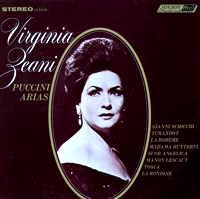
and practically modeled herself after once deciding to become an opera singer (listen to an audio interview here). Before becoming an exclusive artist with EMI, Ms. Gheorghiu had signed with competitor Decca records. It was for this label that Virginia Zeani herself recorded two full studio albums. One recording was an all-Puccini program of arias from Gianni Schicchi, Turandot, Madama Butterfly, Tosca, La Rondine and more, with conductor Franco Patanè. The second operatic recital with conductor Gianandrea Gavazzeni featured coloratura arias from prime Callas territory including La Traviata, I Puritani, Lucia di Lammermoor, La Bohème and
La Sonnambula. In some ways it may seem that Zeani was Decca's answer to EMI's Callas. Recording repertoire wasn't the only thing they shared. In 1952, conductor Tullio Serafin replaced Maria Callas with Virginia Zeani as Elvira in I Puritani at the Teatro Communale in Florence. The bass that evening was Nicola Rossi Lemeni, future husband to Ms. Zeani. So it seems odd that Decca never took advantage of their exclusive rights to Ms. Gheorghiu when they had her in order to make a dedication album to her homeland heroine. One thing that Ms. Gheorghiu does share with Madame Callas is that this "homage" will feature music that dips into mezzo-soprano repertoire (Samson et Dalila, Le Cid, Carmen), something that the latter began to record once vocal decline began to set in. 2012 will mark the 60th anniversary of Callas joining the EMI family and that just might prompt an increase in sales of her greatest recordings. [Source]
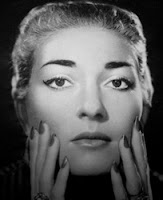
Label Divas: Maria Callas (l) and Virginia Zeani (r) strike similar poses:
"Homage to Maria Callas is a collection of beloved French and Italian operatic masterpieces performed by Angela Gheorghiu, the defining diva of this century. The programme is inspired by the career and recordings of Maria Callas, the greatest diva of the last century. The arias are shared favourites of both Callas and Gheorghiu, and Angela’s new recording demonstrates once again her extraordinary vocal and emotional range. Angela Gheorghiu said recently, 'Callas was original in everything she did; she was a phenomenon. In every performance she gave her all. She was the most wonderful painter and you can always hear exactly the right colour in her voice. Just hearing her sound, you understand all the power or fragility of her emotions. That’s a rare talent and a great gift.' Gheorghiu continued, 'EMI was her record label and it’s mine too. It feels like a family.' Recorded at London’s iconic Abbey Road Studios in London and in New York, the repertoire of Gheorghiu’s first studio recital in six years (during which time she recorded several complete operas, including a multi-award-winning Madama Butterfly), shows her versatility in lyric, spinto and mezzo roles, with each of which she feels a strong emotional connection. These include Mimi (La bohème), Marguerite (Faust), Imogene (Il Pirata), Adriana (Adriana Lecouvreur – an opera which Gheorghiu added to her repertoire in 2010 to great critical acclaim), Maddalena (Andrea Chénier), Nedda (Pagliacci), Wally (La Wally), Medea, Chimène (Le Cid) and Delilah (Samson et Delilah). The new album also includes two arias from the opera that launched her career: La traviata by Verdi, New York Magazine praised at the time that 'Her lady of the camellias is a worthy successor to Garbo and Callas.' [Source]
Did Angela Gheorghiu inadvertently pay tribute to Maria Callas while still on the Decca label with this 1998 release?
Paul Pelkonen reports, "...the most controversial addition to the disc is a digitally built duet between La Gheorghiu and the late Maria Callas. The two sopranos, one living, one very dead, will sing 'L'amour c'est l'oiseaux rebelle,' the Habañera from Act I of Bizet's Carmen. According to a press release (received today from EMI Classics) the new 'duet' was created from the original master tape of Callas' 1961 recording of the aria. The engineers chose this over the '63 recording of the complete opera, because it lacked the usual choral accompaniment. In the engineering booth, the original orchestra (the Orchestre National de la Radiodiffusion Française under the baton of George Prêtre) was scrubbed out. The Royal Philharmonic Orchestra (conducted by Marco Armiliato re-recorded the music, with the players using a special click track to match the original. Ms. Gheorghiu also chose to learn Callas' particular sense of rhythm and meter, enabling the two divas to warble together, or seperately. Leaving aside obvious reservations (the biggest one being that the Habañera is intended for one singer!) the new disc will hit New York's few remaining record shops in October [sic], shortly before Ms. Gheorghiu's scheduled appearance with the Opera Orchestra of New York. In the OONY performance, she will sing the title role in Cilea's Adriana Lecouvrer." [Source]
VERSIONS AVAILABLE:
- Deluxe Edition comprises a CD encased in a hardcover book containing an essay from Angela in three languages, a gallery of glamorous new photos and exclusive access to a video and mini-feature on the making of the CD.
- Standard Edition consists of a CD in a digipack with a booklet excerpting Gheorghiu’s essay. Both Deluxe and Standard editions feature song texts in English, French, German and the original language, if different, as well as booklet text in all three languages.
- Standard Digital Version offers the entire standard CD contents.
RELEASE DATES: USA (9/28), UK (11/7) and Germany (11/18)
Sample tracks by clicking here.
TRACK LISTING:
1. "Donde Lieta Uscì" (Mimì's Farewell): La Bohème, Act Iii
2. "O Dieu! Que De Bijoux" (Jewel Song ): Faust, Act Iii, Scene 6
3. "Col Sorriso D'innocenza": Il Pirata, Act Ii, Scene 3
4. "Qual Fiamma Avea Nel Guardo!...Stridono Lassu": I Pagliacci
5. "Mon Coeur S'ouvre à Ta Voix": Samson Et Dalila
6. "Ebben?...Ne Andrò Lontana": La Wally
7. "L'amour Est Un Oiseau Rebelle" (Habanera): Carmen
8. "La Mamma Morta": Andrea Chénier, Act Iii
9. "Dei Tuoi Figli La Madre": Medea, Act I, Scene 1
10. "De Cet Affreux Combat...Pleurez Mes Yeux": Le Cid
11. "Poveri Fiori": Adriana Lecouvreur
12. "È strano! È strano!...Ah, Fors` è Lui": La Traviata
13. "Follie! Follie!...Sempre Libera": La Traviata - with James Valenti
The Marcello Giordani Foundation presented its annual fundraising concert on December 8, 2010, during which a Lifetime Achievement Award was given to soprano Virginia Zeani. Watch the tribute filled with rare photos from her career and her acceptance of the award, as well as performances by Lise Lindstrom ("Ecco l'orrido camp"), Stephen Costello ("Che gelida manina"), Leah Crocetto ("Tu che di gel sei cinta") and Marcello Giordani ("Ah! leve-toi, soleil!") after the jump.