Showing posts with label Purcell. Show all posts

Sunday, August 16, 2020

Polish Film "The Hater" Uses Bach, Beethoven, Fauré, and Purcell

Dido's Lament: Ewa Majcherczyk is accompanied by string quartet in this 17th-century masterpiece
A new Polish film on Netflix directed by Jan Komasa, The Hater (Sala samobójców. Hejter), features classical music throughout. Selected pieces include  "Ach bleibe dich, mein liebstes Leben" from Ascension Oratorio (Bach); "Ode to Joy" from Symphony #9 (Beethoven); "Les berceaux" Fauré; and "When I Am Laid in Earth" from Dido and Aeneas (Purcell). This last selection is performed by soprano Ewa Majcherczyk in a scene that intersperses shots of the
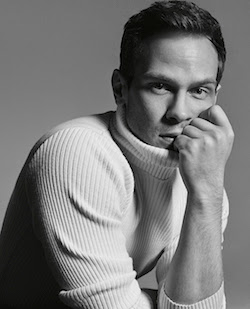
Family Affair: Szymon Komasa
protagonist inside the theater against him working in the office. The significance of the music isn't lost on audiences as the characters in the opera mirror those in the movie with themes like betrayal, envy, jealousy, rejection, and abandonment. This is a sequel to Komasa's 2011 film Suicide Room (Sala samobójców) which also made use of classical music including works of Chopin, Gluck, Mozart, and Schubert. During the closing credits we also hear the director's brother, bass-baritone Szymon Komasa, singing "Lament Hansa" composed by Paweł Mykietyn. The track is featured on the singer's recording Polish Love Story. "An important movie, which exams Scio/Psychopathic behaviour in youth along with sides effects of social media presence in backdrops of political unrest in the world. This seems a lot to handle in one film, but Jan Komasa masterfully handled these subject matters. The film never felt overburden by the issues it tries to examine. Starring: Maciej Musiałowski, Agata Kulesza, Danuta Stenka, Vanessa Aleksander, Maciej Stuhr, Jacek Koman, Adam Gradowski, Piotr Biedroń, Martynika Kosnica"
Silent Obsession: Tomasz (Musiałowski) tries to seduce Gabi (Aleksander) at the disco
Read about the film, watch a video clip of Ewa Majcherczyk singing the Purcell piece, and view the trailer for The Hater after the jump.

Monday, September 29, 2014

"The Strain" Creeps Down The Baroque Opera Path Of Purcell

The young Abraham begs forgiveness for taking the life of his true love after he left her to seek The Master.
As previously discussed, The Strain on FX continues to include opera as part of the show's drama. Episode 12, "Last Rites," aired September 28, 2014, with the climax featuring an excerpt from Henry Purcell's only all-sung dramatic work, Dido and Aeneas. The piece "When I am laid in Earth" plays under the scene of a present, and past, beheading of loved ones fallen prey to the strain. More commonly known as "Dido's Lament," the aria truly expresses the dictionary definition of the word: "la·ment verb \lə-ˈment\: to express sorrow, regret, or unhappiness about something." The music begins as viewers realize that Nora (Mia Maestro) must decapitate her
Present-day Abraham bids farewell to his love.
mother Mariela (Anne Betancourt) as she has recently been turned by Gabriel (Jack Kesy) in an attack on the pawn shop. As the swell of the music increases, we travel in a flashback to 1967 as a younger Abraham (Jim Watson) is faced with having to execute his wife Miriam and their children since they too have been turned and are ready to kill him. As her lifeless body lays on the floor, Abraham takes a knife and cuts her open to remove her heart, which now resides in a jar filled with fluid in the basement of the pawn shop. As Eichorst (Richard Sammel) infiltrates the pawn shop and seeks to execute Abraham, he is forced to leave the only remaining thing in this world that he truly loves: Miriam's heart. As you read the synopsis of Purcell's opera, it is easy to see the parallels to the story line of the show: Miriam as Dido, Abraham as Aeneas, Eichorst as Spirit (née Mercury), and The Master as The Sorcerer. Even the closing lines of the opera after Dido's death include the theme of heart: "The chorus and orchestra conclude the opera by ordering the 'cupids to scatter roses on her tomb, soft and gentle as her heart. Keep here your watch, and never never never part.'" If the show wanted to get a bit creepier,  
perhaps they could have used Symphony #4 "Chiaroscuro" by Gloria Coates which samples the theme of Purcell's aria in a much darker way. Watch the full episode of The Strain by clicking here. More information about Dido and Aeneas, as well as a video performance of Jessye Norman performing "Dido's Lament," can be found after the jump. [Source]
Thomas Eichorst looks down on what has been Miriam's tomb and Abraham's safeguard.

American soprano Jessye Norman as Dido in a costume
designed by Pet Halmen for the l'Opéra de Paris
 (Photo: Zoë Dominic)
DIDO'S LAMENT
"The opening recitative secco, 'Thy hand, Belinda,' is accompanied by continuo only. Word painting is applied on the text 'darkness' and 'death' which is presented with chromaticism, symbolic of death. 'Dido's Lament' opens with a descending chromatic fourth line, the ground bass, which is repeated eleven times throughout the aria, thus structuring the piece in the form of a ciaccona. The meter is 3/2 in the key of G minor. Henry Purcell has applied word painting on the words 'laid,' which is also given a descending chromatic line portraying death and agony, and 'Remember me,' which is presented in a syllabic text setting and repeated with its last presentation leaping in register with a sudden crescendo displaying her desperate cry with urgency as she prepares for her fate: death. In one interpretation Dido's relationship with Aeneas is portrayed in this moment as an 'apocalyptic romance.' The text, and the Purcell opera are alluding to the Roman legend of the Aeneid, the story of a Trojan Warrior Aeneas, seeking Italy in order to settle there and secure his son's lineage. Aeneas is blown off course from Sicily, and lands on the shores of Northern Africa, in Carthage, a recently settled city of former Tyrians. Their queen is Dido, with whom Aeneas has a love affair, before departing for Italy and leaving Dido alone. She becomes so distraught that she orders for a large pyre to be placed, on which she plans to impale herself, and be set ablaze so that Aeneas will see from his ship. This is perhaps the most poignant part of the legend, and ends at the culmination of Book IV." [Source]

Thursday, November 10, 2011

Where in the Opera Would Purcell Place the Product Exactly?

"Wellaflex Silvikrin, the UK’s No1 Hairspray has been trusted by generations of British women for over 50 years to offer reliable and flexible 24hr hold at a smart price, helping to give women the confidence to know they are set and ready for the day, prepared for wherever their social calendar takes them. To celebrate its Heritage, Wellaflex Silvikrin is now the proud official sponsor of English Touring Opera’s production of Purcell’s The Fairy Queen and we are offering you two tickets to attend the Opera at Exeter Northcott Theatre on November 17, 2011. What’s more, you will also win a year’s supply of Wellaflex Silvikrin Hairspray! A classic, but refreshed, hairstyle will give you the finishing touches to your look for such an occasion and ensure you and your friends are ‘set and ready’ for your night at the Opera. The latest Wellaflex Silvikrin Hairspray range offers reliable, long-lasting hold, whilst keeping your style flexible. The Classic range includes five great variants, providing five levels of hold to suit every hair style including Firm, Flexible, Natural, Secure and Maximum Hold." [Source]


This isn't the first time hair products have crossed over into the opera world. Check out the commercial after the jump.