Showing posts with label June Anderson. Show all posts

Saturday, November 8, 2014

Top Singers Commemorate The Fall Of Berlin Wall 25th Anniversary

UPDATE 11/10/2014: Jonas Kaufmann was replaced by heldentenor Klaus Florian Vogt as seen in the photo below. Watch the finale of the performance from Sunday evening by clicking here.
==================================================================
The Brandenburg Gate Quadriga
On November 9, 2014, conductor Daniel Barenboim will step onto the podium in front of the Brandenburg Gate to conduct the Staatskapelle Berlin in Beethoven's Symphony No. 9 to commemorate the 25th Anniversary of the Berlin Wall falling. Soloists will include Renée Fleming, Elīna Garanča, Jonas Kaufmann, and René Pape. "The performance is part of a three-day, city-wide celebration of the Fall of the Berlin Wall, which includes a 15 kilometer Lightgrenze, or Light Frontier, from the Wall Memorial to the Brandenburg Gate. The Lightgrenze, by artist Christopher Bauder and filmmaker Marc Bauder, comprises 8,000 illuminated white balloons, each with its own story and patron. The installation also includes large-screen projections of historical film collages, along with guided tours and public exhibits. Barenboim and the Staatskapelle Berlin’s performance will coincide with the release of the 8,000 balloons as they sail above the German capital. The performance will be broadcast on ARD and rbb beginning at 6.50 p.m. CET. Tell the world about your experiences of witnessing the fall of the Berlin Wall and what the Peaceful Revolution of 1989 means to you today. Use the hashtags #fallofthewall25 or #fotw25 on Facebook, Instagram and Twitter, and your message will appear in the virtual web portal here." [Source]
As we look back to that historic moment in 1989, let's remember the concert that marked the original event: "On December 25, 1989, Leonard Bernstein gave a concert in Berlin celebrating the end of the Wall, including Beethoven's 9th symphony ('Ode to Joy') with the word 'Joy' (Freude) changed to 'Freedom' (Freiheit) in the lyrics sung." The quartet of soloists were comprised of singers from around the world: soprano June Anderson, mezzo-soprano Sarah Walker, tenor Klaus König, and bass Jan-Hendrik Rootering. Conductor Leonard Bernstein led a chorus and orchestra was comprised of members from the Chor des Bayerischen Rundfunks, Rundfunkchor Berlin, Symphonieorchester des Bayerischen Rundfunks & Members of the
American soprano June Anderson and British mezzo-soprano
Sarah Walker singing at the historic event in 1989.
Staatskapelle Dresden, Orchestra of the Kirov Theatre, London Symphony Orchestra, New York Philharmonic, Orchestre de Paris. "The fall of the Berlin Wall on November 1989 unleashed a wave of democratisation in Central and Eastern Europe that radically transformed the world order. In a typically grandiose yet eloquent gesture, Leonard Bernstein spontaneously accepted an invitation to conduct a performance of Beethoven’s Ninth Symphony to celebrate this freedom....In a typically grandiose yet eloquent gesture, Bernstein spontaneously accepted an invitation to conduct a performance of Beethoven’s Ninth Symphony to celebrate this freedom. It was only fitting that East Germany’s new-found freedom should be celebrated with Beethoven’s Ninth Symphony. The monumental works, perhaps the world’s most famous Symphony, was inspired by Schiller's poem “Ode to Joy”, a passionate paean to freedom. Adding to the symbolism of the event, Bernstein conducted an orchestra and chorus formed of musicians from both East and West Germany (Bavarian Radio Symphony Orchestra, Staatskapelle Dresden), as well as the United States (New York Philharmonic), Great Britain (London Symphony), France (Orchestre de Paris) and the Soviet Union (Orchestra of the Kirov
Polish-born and German raised tenor Klaus König and
German-born of Dutch ancestry bass Jan-Hendrik
Rootering sing Beethoven for Bernstein.
Theater). Recorded at the Schauspielhaus, Berlin, December 25, 1989, the German label Deutsche Grammophon would commemorate the event by issuing multiple CD versions with different title and one limited edition copy that contained a piece of the Berlin Wall for collectors. "The Berlin Wall (German: Berliner Mauer) was a barrier that existed between 1961 and 1990, constructed by the German Democratic Republic (GDR, East Germany) starting on August 13, 1961, that completely cut off (by land) West Berlin from surrounding East Germany and from East Berlin until it was opened in 1989. The barrier included guard towers placed along large concrete walls, which circumscribed a wide area (later known as the 'death strip') that contained anti-vehicle trenches, 'fakir beds' and other defenses. The Eastern Bloc claimed that the wall was erected to protect its population from fascist elements conspiring to prevent the 'will of the people' in building a socialist state in East Germany. In practice, the Wall served to prevent the massive emigration and defection that marked East Germany and the communist Eastern Bloc during the post-World War II period....In 1989, a series of radical political changes occurred in the Eastern Bloc, associated with the liberalization of the Eastern Bloc's authoritarian systems
Lucky collectors were able to get a recording of the
event with a piece of the Berlin Wall inside
and the erosion of political power in the pro-Soviet governments in nearby Poland and Hungary. After several weeks of civil unrest, the East German government announced on November 9, 1989, that all GDR citizens could visit West Germany and West Berlin. Crowds of East Germans crossed and climbed onto the wall, joined by West Germans on the other side in a celebratory atmosphere. Over the next few weeks, euphoric public and souvenir hunters chipped away parts of the wall; the governments later used industrial equipment to remove most of what was left. Contrary to popular belief the wall's actual demolition did not begin until Summer 1990 and was not completed until 1992. The fall of the Berlin Wall paved the way for German reunification, which was formally concluded on October 3, 1990." [Source, Source] Watch the finale of that historic concert from 25 years ago, and see the different packaging for the DG recordings, after the jump.

Sunday, October 23, 2011

Looking Back at June Anderson Interview For Opéra Magazine

Longtemps étiquetée spécialiste de Rossini, Bellini et Donizetti, la soprano américaine, sans renoncer aux emplois qui ont fait sa gloire, tente de nouvelles aventures depuis une dizaine d’années. En attendant Pat Nixon dans Nixon in China au Châtelet, la saison prochaine, elle aborde Salomé à Liège, le 7 juin, dans la version française de l’ouvrage, élaborée par Richard Strauss sur le texte original d’Oscar Wilde.

Read excerpts from the interview after the jump.

Thursday, September 29, 2011

Metropolitan Opera Guild Luncheon to Honor Marilyn Horne

The lady of the hour: Miss Horne
77th Annual Guild Luncheon
Jackie! Celebrating Marilyn Horne
October 31, 2011 12:15 PMWaldorf-Astoria

The honoree of this year’s Annual Guild Luncheon is the legendary Marilyn Horne. Join us as we salute one of the greatest singers of our time, with appearances by her colleagues and friends, video performances and a vocal tribute by Stephanie Blythe. Guests at the luncheon will include June Ander­son, Lucine Amara, Mar­tina Arroyo, Har­o­lyn Black­well, Judith Ble­gen, Richard Bonynge, Nedda Casei, Barbara Cook, Frank Corsaro, John Corigli­ano, Dwayne Croft, Tyne Daly, Ray­mond Gniewek, Florence Henderson, Martin Katz, Jean Kraft, Shir­ley Love, John Mac­urdy, Spiro Malas, Terrence McNally, Marnie Nixon, Betsy Norden, Roberta Peters, Eve Queler, Samuel Ramey, Regina Res­nik, Ren­ata Scotto, Rita Shane, Bryn Ter­fel, Ben­ita Valente, Deborah Voigt, Fre­der­ica von Stade and Robert White.

TICKETS
Regular Tickets: $250 ($125 tax-deductible)
Benefactor Tickets: $475 ($350 tax-deductible)
President’s Circle Tickets: $750 ($625 tax-deductible)
Benefactor Tables for Ten: $4,750 ($3,500 tax-deductible)
President’s Circle Tables for Ten: $7,500 ($6,000 tax-deductible)

Buy tickets for the event by clicking here.

Friday, September 2, 2011

Daniel Auber Still Shocks Brussels With "La Muette de Portici"

"Nearly everyone in Belgium has heard of The Mute Girl of Portici, the opera that, in 1830, sparked the Belgian revolution. But few have ever seen it performed. That could change, however, because the Théâtre Royal de la Monnaie is staging a new performance for the upcoming opera season. Except that it won’t be produced in Brussels but in Paris as a co-production with the Opéra Comique. 'We did it knowingly,' says the director of La Monnaie, Peter De Caluwe. Staging the opera now, in Brussels, would not only be an artistic act but it would also be a political manifesto and interpreted as an argument in favour of Belgian unity at a moment when the political situation is precarious. 'It isn’t the right time,' says Peter De Caluwe, 'because it would raise the question of whether or not we need Belgium. I want to withdraw opera from the debate.' Writer Geert Van Istendael, who had to learn excerpts of The Mute Girl of Portici by heart in primary school, agrees with Peter De Caluwe. 'Staging the opera in Brussels today, in the political swamp in which we are wading would be a crushing blow,' he said. On August 16, discussions resumed over the formation of a Belgian government. Mistrust between the Flemish and the Walloons runs so high, that negotiations have been on-going for fourteen months. King Albert, one of the last symbols of unity left, last month blasted politicians for failing to find a compromise and warned against Poujadisme – an allusion to the French populist movement of the 1950s. In such a climate, staging The Mute Girl of Portici is considered dynamite on the political front." Find out more about this opera's politically charged history by reading the whole story here. [Source]

Listen to June Anderson sing "Arbitre d'une vie" by clicking here.

Listen to Alfredo Kraus and Jean-Philippe Lafont sing "Amour sacré de la Patrie" by clicking here.

Listen to Frieda Hempel sing "O Moment enchanté" by clicking here.

Lise Noblet as Fenella in La Muette de Portici 

Information about the artwork on the right: Color lithograph by Achille Devéria, Paris, [184-]. First performed at the Paris Opéra in 1828, La Muette de Portici was an opera-ballet with music by Daniel Auber, choreography by Jean-Louis Aumer, a singing hero (the fisherman Masaniello), and a dancing heroine (the mute Fenella). The work, set in Naples during a seventeenth-century revolt against the Spaniards, capitalized on the Romantic era's fascination with local color, evident in the treatment of Fenella's costume. Many French works of the Romantic period had Italian settings and featured classicized versions of Italian folk dances. Cia Fornaroli Collection, Jerome Robbins Dance Division. [Source]

More information about the opera, original cast list and a detailed synopsis after the jump.

Coffee Break: Rosalind Plowright "Il Corsaro" 1982 San Diego


Rosalind Plowright (Medora), June Anderson (Gulnara) and Alfonso Navarrate (Corrado)

Wednesday, June 8, 2011

June Anderson Sings "Salomé" For Opéra Royal de Wallonie

Opéra Royal de Wallonie in Liège, Belgium, will present the Richard Strauss opera in its French version on June 7, 9, 12, 15 and 18. See more pictures and videos of the production here.

Donald Kaasch (Hérode), Mara Zampieri (Hérodiade) and June Anderson (Salomé)
"Après l'échec de ses deux premiers opéras – qui ne sont d‘ailleurs plus joués aujourd’hui –, Richard Strauss décida de mettre en musique la Salomé d’Oscar Wilde. Lors de la création à Dresde en 1905, le succès fut colossal, bien aidé par le parfum de scandale qui émanait de l'oeuvre et auquel le public ne put résister. Le Metropolitan Opera de New York, par contre, retira l'oeuvre de l'affiche après la première représentation en 1907 et elle y resta interdite durant 17 ans. Vienne, Londres la bannirent aussi, de même que Salzbourg où un certain Herbert von Karajan fut le premier à oser braver l'interdiction en 1929. Il faut dire que Salomé
associait à un thème biblique un érotisme débridé pour l'époque. Il est d'ailleurs surprenant de constater que la célèbre "Danse des sept voiles" choqua autant l'assistance que la scène suivante. On y voit alors Salomé se faire amener sur un plateau la tête coupée de Jean-Baptiste qu'elle embrasse en lui déclarant son amour. Bien que la version allemande soit la plus souvent représentée, Strauss composa également, sur le modèle de la nouvelle de Wilde, une version en français, créée à Bruxelles en 1907. C'est cette version rarement proposée que l'Opéra Royal de Wallonie a choisi de présenter. Ce spectacle qui clôturera brillamment la saison présente a plus d'un atout : un cast prestigieux où on retrouve dans les rôles de Salomé et Hérodiade, une vraie star du chant, June Anderson, et une autre grande dame de l'art lyrique, Mara Zampieri. À la tête de l'orchestre de l'Opéra Royal de Wallonie, notre directeur de la musique Paolo Arrivabeni qui nous montrera, dans cet ouvrage, une autre facette de son talent." [Source]

Wednesday, February 23, 2011

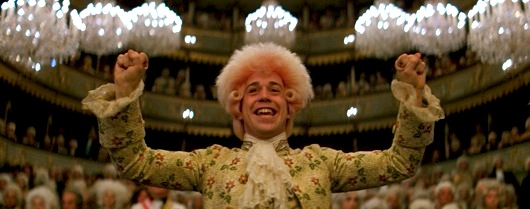
The Amadeus Effect: How A 1984 Film Succeeds On Many Levels

Actor Tom Hulce portraying Wolfgang Amadeus Mozart in what would become the role of a lifetime.

TCM is running Academy Award-winning movies all month long as a lead-up to this year's awards ceremony on February 27. Last night's feature was the 1984 musical bio-pic Amadeus. Written by Peter Shaffer and directed by Miloš Forman, the story is told from the perspective of Antonio Salieri who is delirious with fictionalized jealousy for a contemporary composer named Wolfgang Amadeus Mozart. Perhaps at first glance the project may not have appealed to a high-brow society that puritanically fills concert halls and opera houses but it manages to introduce moviegoers to wonderful Mozart compositions, some for the first time. "Amadeus is a magnificent film, full and tender and funny and charming -- and, at the end, sad and angry, too, because in the character of Salieri it has given us a way to understand not only greatness, but our own lack of it. This movie's fundamental question, I think, is whether we can learn to be grateful for the happiness of others, and that, of course, is a test for sainthood." - Rogert Ebert, film critic. Read more about Mozart, Salieria, the cast of the film, and learn more about the music featured in Amadeus, after the jump.

Tuesday, February 15, 2011

June Anderson Began Career Singing Rare Works and Musical

June in 1986 (Photo: Opera News)
In a new interview with June Anderson, she discusses her early beginnings singing in New Haven, Connecticut. Her first performance was at age 14 in the opera La Princesse au petit pois (1927) by Ernst Toch. She went on to do Haydn's Infedeltà Delusa and her first Gilda in Rigoletto at age 17. She also sang in a high school production of Show Boat. It was also pointed out to her at the start of her taking singing lessons that her voice was reminiscent of Erna Berger. [Source]

Thursday, February 3, 2011

Contact High: June Anderson

La Sonnambula - "Ah, non giunge"
June Anderson
Julius Rudel, NYC, 1996
Clip length (0:29)


con·tact high [kon-takt hahy]: when you feel the slight, brief sensation of being high just because you were close to somebody that was definitely high.

Monday, January 3, 2011

Le Fils De Cadix: Ismael Jordi

In 1973 tenor Ismael Jordi was born in Jerez de la Frontera, a municipality in the province of Cádiz in the autonomous community of Andalusia in southwestern Spain situated midway between the sea and the mountains. His great-grandmother was the only one with musical abilities in his family. He was a semi-professional soccer player, but was always interested in singing. He took voice lessons with Argentinian tenor Daniel Munoz.

He attended Madrid's Escuela Superior de Música Reina Sofía starting in 1998. He studied voice with Alfredo Kraus for two years. He went on to take lessons with Suso Mariategui, Edelmiro Arnaltes, Teresa Berganza and Manuel Cid. He currently studies voice with Angelo Capobianco in Verona.