Showing posts with label Grace Bumbry. Show all posts

Monday, July 13, 2015

Leading Ladies Of The Late Jon Vickers In Opera Performances

Jon Vickers (center) and Leontyne Price (right) are seen talking with producer Richard Mohr
during the recording of Verdi's Aida for RCA in 1961 at the Rome Opera.
With the most recent passing of the heroic tenor Jon Vickers, we look back at the outstanding roster of female partners he had on the opera stage and in the recording studio. During an era when operatic pairings like Callas & Di Stefano, Tebaldi & Del Monaco, and Nilsson & Corelli were commonplace, the Canadian powerhouse voice of Jon Vickers sang with voices as far-ranging as Teresa Stratas to Gré Brouwenstijn. Find more astounding clips featuring Katia Ricciarelli, Renata Scotto, Joan Sutherland, Montserrat Caballé, Maria Callas, Jessye Norman, and many more, after the jump.

Sunday, January 4, 2015

Celebrate The Birthday Of Legendary Grace Bumbry

Today marks the 78th birthday of opera singer Grace Bumbry. See a selection of rare photos after the jump that give a glimpse into her glamorous life and read more extensively about the singer's life by clicking here.

Wednesday, November 26, 2014

Grace Bumbry Will Perform To Honor Martin Luther King Jr.
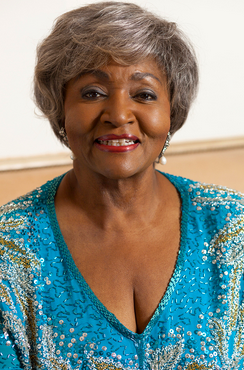
La Bumbry: The legend will make a rare
appearance for this celebratory concert
in New York City this January.
The concert, titled Celebrating a King, will mark a rare performance by the legendary opera star Grace Bumbry. "Fill your Martin Luther King, Jr. holiday with thrilling music. On January 17 and January 19, 2015 Courtney's Stars of Tomorrow honors the life and singular achievement of Dr. Martin Luther King, Jr. in music. Legendary mezzo-soprano and 2009 Kennedy Center honoree Grace Bumbry makes an all too rare US appearance to sing Brahms' masterwork, Alto Rhapsody (Op.53), conducted by Ted Taylor. Adding to the celebration are three magnificent singers who command the stage in these special concerts, which showcase their tremendously expressive powers. This tour de force will be co-conducted by rising star conductor Ramon B. Braxton. Please call 1-800-838-3006 for special seating arrangements or wheelchair access." [Source] Purchase tickets by clicking here. The concert poster with details of the additional singers on the program can be found after the jump.

Saturday, June 7, 2014

Leyla Gencer And Grace Bumbry In Unconventional Performance

Grace Bumbry (left) and Leyla Gencer (right) appear backstage during performances of Monteverdi's L'incoronazione di Poppea at La Scala in 1967. Listen to the performance here.  See some other unique casting choices for this Baroque piece, after the jump.
"L'incoronazione di Poppea (SV 308, The Coronation of Poppaea) is an Italian opera by Claudio Monteverdi, with a libretto by Giovanni Francesco Busenello, first performed at the Teatro Santi Giovanni e Paolo in Venice during the 1643 carnival season. One of the first operas to use historical events and people, it describes how Poppaea, mistress of the Roman emperor Nero, is able to achieve her ambition and be crowned empress. The opera was revived in Naples in 1651, but was then neglected until the rediscovery of the score in 1888, after which it became the subject of scholarly attention in the late 19th and early 20th centuries. Since the 1960s, the opera has been performed and recorded many times. The original manuscript of the score does not exist; two surviving copies from the 1650s show significant differences from each other, and each differs to some extent from the libretto. How much of the music is actually Monteverdi's, and how much the product of others, is a matter of dispute. None of the existing versions of the libretto, printed or manuscript, can be definitively tied to the first performance at the Teatro Santi Giovanni e Paolo, the precise date of which is unknown. Details of the original cast are few and largely speculative, and there is no record of the opera's initial public reception. Despite these uncertainties, the work is generally accepted as part of the Monteverdi operatic canon, his last and perhaps his greatest work. In a departure from traditional literary morality, it is the adulterous liaison of Poppea and Nerone which triumphs, although this victory is demonstrated by history to have been transitory and hollow. Moreover, in Busenello's version of the story all the major characters are morally compromised. Written when the genre of opera was only a few decades old, the music for L'incoronazione di Poppea has been praised for its originality, its melody, and for its reflection of the human attributes of its characters. The work helped to redefine the boundaries of theatrical music, and established Monteverdi as the leading musical dramatist of his time. [Source]

Friday, April 29, 2011

A History of "Orfeo ed Euridice" at the Metropolitan Opera

Risë Stevens as Orfeo (Photo: Tony Vaccaro)
As Gluck's opera Orfeo ed Euridice is set to open tonight at the Metropolitan Opera with David Daniels, let's take a look back at the many stars who have sung the role of Orfeo at this famous company. The first performance given by the MET was actually at the Boston Theatre in Massachusetts and was sung in German with Marianne Brandt taking on the lead role in 1885. The next performance took place in 1891 with Giulia Ravogli singing Orfeo in Chicago, Illinois. In an interesting pairing, the work received its premiere at the Metropolitan Opera in New York City on December 11, 1893, with Leoncavallo's I Pagliacci taking the second part of the evening. Sofia Scalchi sang Orfeo and Nellie Melba sang Nedda. Quite an interesting night to be sure. The production returned in 1895 with Marie Brema as Orfeo and this time sharing the evening with Emma Calvé as Anita in the U.S. premiere of Massenet's La Navarraise. The opera gets revived in 1909 with Louise Homer in a new production with a drastically revised score by conductor of the performances, Arturo Toscanini. Marie Delna makes her debut as Orfeo in the last performance of this run. The original cast of this production returned for the 1910-11 and 1911-12 seasons for a revival with Margarete Matzenauer stepping in for one performance as Orfeo. There is one more performance on March 2, 1914, before this production takes a respite until 1936 when Orfeo ed Euridice returns to the MET in a new production conceived by George Balanchine that puts the singers in the orchestra pit and dancers portraying them on stage. Anna Kaskas was Orfeo
David Daniels as Orfeo at the Metropolitan (Photo: Annie Leibovitz)
and the performance was on a double-bill with Mascagni's Cavalleria Rusticana. Kerstin Thorborg arrives in 1938 as Orfeo in a new production directed by Herbert Graf with sets by Harry Horner. When brought back in 1939, Erich Leinsdorf takes over conducting duties when Artur Bodanzky passes away and in 1941, Bruno Walter steps into the pit for Maestro duties. In February 1955, a new era began with Risë Stevens taking on the title role under conductor Pierre Monteux. From this point on a series of popular mezzo-sopranos including Grace Bumbry (1970) and Marilyn Horne (1972). The opera disappeared until the current Mark Morris production premiered in 2007 with costumes by Isaac Mizrahi and conducted by James Levine. The performances also marked the MET role debut as Orfeo for David Daniels. The role was put back in the hands of mezzo-soprano Stephanie Blythe when the production was revived in 2009. In addition to countertenor David Daniels, the current run will mark the debut of soprano Kate Royal as Euridice and the Amor of Lisette Oropesa, all under conductor Antony Walker. [Source]

A listening guide through various interpretations of "Che farò senza Euridice" throughout MET history:

Risë Stevens

Grace Bumbry

Marilyn Horne

Tuesday, January 4, 2011

Happy Birthday: Grace Bumbry

Grace Bumbry (born January 4, 1937) is an American opera singer, and is considered one of the leading mezzo-sopranos of her generation, as well as a major soprano for many years. She was a member of an extraordinary and pioneering generation of singers who followed Marian Anderson (including Leontyne Price, Martina Arroyo, Shirley Verrett and Reri Grist) in the world of classical music and paved the way for future African-American opera and classical singers. 

Bumbry's voice was rich and sizable, possessing a wide range, and was capable of producing a very distinctive plangent tone. In her prime, she also possessed good agility and bel canto technique (see for example her renditions of the "Veil Song" from Verdi's Don Carlo in the 1970s and 1980s, as well as her Ernani from the Chicago Lyric Opera in 1984).