Showing posts with label Zachary Woolfe. Show all posts

Monday, October 31, 2011

Marilyn Horne Is a Treasure Among Treasures in Operatic History

The mezzo-soprano in her New York apartment during the
1980s, with centuries worth of opera history on the walls.
"On the walls of her apartment is a small but exquisite collection of letters and portraits of the great 19th century singers and composers: Meyerbeer, Verdi, Johann Strauss, Emma Calve. There is a photo of Pauline Viardot, an original lithograph of one of the last of the castrati, a letter written by Maria Malibran. There is something that feels very natural about it all being there: This is the company Horne belongs in. The masterpiece of the collection may be a small piece of paper, little more than a scrap. It is a bit of music manuscript, and it the last song Bellini ever wrote. Horne sang it out in a voice still clear and assured (the qualities that, along with her legendary diction, will come in handy when she sings Katisha in The Mikado with the Collegiate Chorale at Carnegie Hall this spring)." [Source]

Friday, October 7, 2011

Interview With the Three Male Leads of the MET "Don Giovanni"

The British (Grandage), Polish (Kwiecen) and Italian (Luisi)
will recreate the Spanish legend of Don Juan.
(Photo: Robert Wright/New York Times) 
Zachary Woolfe has an interesting conversation with the director (Tony Award-winner Michael Grandage), the maestro (Principal Conductor Fabio Luisi) and the Don Giovanni (baritone Mariusz Kwiecen) about the new production of Don Giovanni at the Metropolitan Opera: "Even if Mr. Grandage, 49, and Mr. Luisi, 53, bring fresh perspectives to the opera, it helps that they are working with singers well versed in the classic roles, including the baritone Mariusz Kwiecien, who had his breakthrough year at the Met in 2005 in two Mozart parts — the Count in Le Nozze di Figaro” and Guglielmo in Così Fan Tutte — under Mr. Levine. Mr. Kwiecien has made something of a specialty of the libertine Don." [Source]

Wednesday, October 5, 2011

A History of Breaking Down the Fourth Wall on the Opera Stage

It is hard to forget that you are watching Anna Netrebko as
Anna Bolena whether she smiles or not. (Photo: Ken Howard/MET)
"The soprano Anna Netrebko was singing the fiendishly difficult title role in Donizetti’s Anna Bolena. The final scene began with her achingly beautiful rendition of the aria 'Al dolce guidami,' its final note slowly diminishing to nothing. The audience erupted in cheers that went on far longer than is usual at the Met these days. Ms. Netrebko, who had ended the aria gazing upward, suddenly gave a wide smile, driving the audience to even greater applause. The critics were not amused....That was what was so moving about Ms. Netrebko’s smile. The illusion shared by an operatic audience is strengthened, not weakened, by its occasional collapse. Opera is drama, yes—thanks to people like Callas, those values were restored. But it is also sheer performance, a quality that is allowed to subvert that drama from time to time. To be serious, opera has to be fun....As it happens, Ms. Netrebko was in the house. At intermission The Observer went over and asked her what had happened at the end of 'Al dolce guidami.' 'Well, I don’t know, it was just a smile to the conductor,' she said. 'It was kind of like, ‘O.K., we did it. It was good. The audience is applauding.’ It’s a beautiful moment to stay on the stage of the Met and receive all this applause, you know? It’s really a great moment. I think if it’s done just a little bit, without going too far, it’s O.K.'” [Source]

Friday, September 2, 2011

Zachary Woolfe Recommends Cavalli's Mega-Hit "Giasone"

Jason & Medea (Giovanni Crosato)
Writer Zachary Woolfe makes a recommendation for New Yorkers in today's edition of the Times: "Opera Omnia (Friday, Saturday, Tuesday and Wednesday) Giasone, which had its premiere in Venice in 1649, was Cavalli’s most popular opera in his own time but is a rarity now. That’s a shame, as it features gorgeous music, complex characters and a knowing libretto that treats the story of Jason’s quest for the Golden Fleece with a mixture of emotion and absurdity. This excellent young company is mounting it (in English) in a production directed by Crystal Manich and conducted by Avi Stein, with a cast that includes the dazzling mezzo-soprano Hai-Ting Chinn as (who else?) Medea. At 7 p.m., Le Poisson Rouge, 158 Bleecker Street, near Thompson Street, Greenwich Village, (212) 505-3474, lepoissonrouge.com; $30 for general seating, $15 for bar/mezzanine seating." [Source]


"Delizie, contenti" Giasone (Cavalli) sung by René Jacobs
"Dell'antro magico" Giasone (Cavalli) sung by Gloria Banditelli
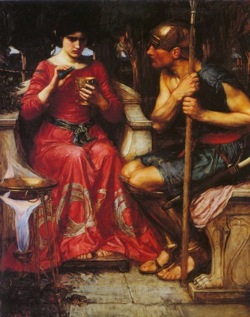

Jason and Medea (John William Waterhouse)
"Opera Omnia presents Francesco Cavalli's Giasone, fully staged in English translation, as a long overdue follow-up to Opera Omnia's sold-out run of Monteverdi's Coronation of Poppea in 2008. Giasone was the most popular opera of the 17th century; this raucous telling of the Jason and Medea myth features tortured lovers, a bitter old maid, a buffoon servant...and a stuttering hunchback. Using a style that incorporates commedia dell'arte and cabaret, Opera Omnia's version of the quest for the Golden Fleece is sure to delight. Returning Opera Omnia cast members include Hai-Ting Chinn (Medea) and Cherry Duke (Jason), who will be joined by Kathaine Dain (Hipsipyle), Karim Sulayman (Delfa), and Nathan Baer (Besso), with music direction by Avi Stein and stage direction by Crystal Manich, produced by Wesley Chinn. [Source]

Watch some videos featuring Hai-Ting Chinn after the jump.

Friday, August 19, 2011

Zachary Woolfe Explores "Charisma" in Opera Singers

Mirror, mirror on the wall, who is the most
charismatic of them all?
Maria Callas photographed by Angus McBean.
"Charismatic performers are those whom you simply can’t look away from. Their charisma is an almost physical presence, a spark that powers even the most unassuming musical passage. To experience a charismatic performance is to feel elevated, simultaneously dazed and focused, galvanized and enlarged. It is to surrender to something raw and elemental, to feel happy but also unsatisfied. Charisma calls forth a melancholy, a vaguely unrequited feeling. I’ve caught myself, after certain performances of an aria or a movement, leaning forward, as if drawn against my will. Charisma requires that you acknowledge a new, larger set of possibilities. It is demanding. We are told of Callas’s overwhelming use of her body and voice onstage. As Schonberg added, of that 1965 Tosca, 'the stage presence shown by Callas in her performance would have raised the hackles on a deaf man.' The question is whether people want to be swept up. Charisma can be exhilarating but also frightening. Our surrender to it demands a trust that is not easily conceded. If our desire from performance is only for comfort and reassurance, charisma will repel us. It is about revealing scope, and it raises the stakes dangerously high....Recently I was in the Met Opera Shop, and a video clip came on the screen above the CD racks. The longtime Met soprano Aprile Millo was singing 'La mamma morta,' the ecstatic aria from Giordano’s Andrea Chenier, with burning intensity. The sales clerk and I both watched raptly. Later I e-mailed Ms. Millo to ask her what charisma is. 'Hemingway gave us a haunting clue to it,' she replied. 'In his obsession with the Spanish bullfights, he spoke of the lust of the crowd and its desire to feel something special, a raw authenticity, even in so brutal a setting. What he mentions is the hush that would come over the crowd at the entrance of the toreadors. The people could sense the difference between those who did it for the fame, the paycheck, and those who had the old spirit: the nobility, bravery, heart, ‘duende.’ I believe this also happens in the theater. The crowd can sense the one with the authentic message, the connection to the truth.'" [Source]

Monday, March 21, 2011

Michelle DeYoung as Judith
(Photo: Brian Harkin/The New York Times)
"The centerpiece of Friday’s program at Avery Fisher Hall was a taut, darkly radiant performance of Bartok’s one-act opera Duke Bluebeard’s Castle. The work is a moody, stylized fairy tale about the duke and his new wife, Judith, who after gradually opening seven locked doors in her husband’s castle finally reveals the three former wives he has murdered. As the opera ends, she takes her place among them...For sheer power few moments in music can compete with the C major blasts at the opening of the fifth door, behind which lies Bluebeard’s expansive kingdom. As the Avery Fisher house lights were suddenly thrown on, the Philharmonic’s brass section shone, and the excellent mezzo-soprano Michelle DeYoung, as Judith, unleashed a thrilling high C." [Source]