![]() |
| The relaxed diva not concerned about the MET (Photo: Pierre Mandereau) |
Thursday, May 26, 2011
Anna Caterina Antonacci Is Just Fine Not Singing at the MET
Wednesday, May 25, 2011
Happy Birthday: Beverly Sills
![]() |
"Ah perche, giusto ciel" Rodelinda (Händel) |
![]() |
"Al dolce guidami...coppia iniqua" Anna Bolena (Donizetti) |
Labels:
Beverly Sills,
Birthdays
Monday, May 23, 2011
Happy Birthday: Ingeborg Hallstein
Ingeborg Hallstein was born May 23, 1936, in Munich, Germany. She studied with her mother Elisabeth Hallstein and debuted at the opera house in Passau/Germany in 1957 as Musetta in Puccini's La bohème. After engagements at the Theatre of Basel and the Staatstheater am Gärtnerplatz in Munich she made her Salzburg Festival debut in 1960 as Rosina in Mozart's La finta semplice. The same year she joined the Bavarian State Opera, a full member there from 1961 until 1973. In the following years guest appearances led her to almost every important opera house in the world, including among others Deutsche Oper Berlin, Hamburg State Opera, Teatro La Fenice in Venice and the Teatro Colón in Buenos Aires. She also sang at
the Royal Opera House in London under Otto Klemperer and created one of her signature roles for the re-opening of the Theater an der Wien under the baton of Herbert von Karajan: the Queen of the Night in Mozart's Die Zauberflöte. Her repertoire of operatic roles reveals an artist who has an accurate and smart sense of her own musicianship. Her voice was well focused and she was capable of commanding dramatic phrasing and emotional expression. In opera she sang some of the most demanding roles in the coloratura Fach, e.g. Zerbinetta in Richard Strauss' Ariadne auf Naxos, Violetta in Verdi's La traviata, Zaide in Mozart's Zaide and the already mentioned Queen of the Night in Die Zauberflöte. Apart from her appearances on the opera stage she devoted herself
to the Lied, giving countless Lieder recitals in Germany and abroad. In 1979 she was appointed professor at the Music Conservatory in Würzburg. After initial doubts, teaching became her new passion and she decided to retire from stage and concentrate on the young talents. Hallstein taught in Würzburg until 2006. Today (as of 2009) she gives master classes in Germany and abroad and is a sought-after juror for international singing competitions. An exclusive contract with the renowned German record label Deutsche Grammophon resulted in numerous recordings of operas, operettas and songs. These recordings display an artist who had an uncanny sense of sophistication in terms of ornamentation and a fearless bravura approach to the most
daring virtuoso pieces. Besides her very successful stage career, she also achieved great popularity during the 1960s and 1970s when she appeared in many operetta films like Die Zirkusprinzessin or Wiener Blut, and musical shows broadcast on German television. For her great services, among other things to the young talents, the Bayerische Kammersängerin received the Federal Cross of Merit in 1979, that order's First Class in 1996, and the Bavarian Order of Merit in 1999. [Source]
"Ou va la jeune Hindoue?" Lakmé
"Ombre légère" Dinorah
"Der Hölle Rache" Die Zauberflöte
"E' strano!...Ah, fors'e' lui...Sempre libera" La Traviata (in German)
"Una voce poco fa" Il Barbiere di Siviglia (in German)
"No, no, che non sei capace" K. 419
More photos of Ingeborg Hallstein after the jump.
the Royal Opera House in London under Otto Klemperer and created one of her signature roles for the re-opening of the Theater an der Wien under the baton of Herbert von Karajan: the Queen of the Night in Mozart's Die Zauberflöte. Her repertoire of operatic roles reveals an artist who has an accurate and smart sense of her own musicianship. Her voice was well focused and she was capable of commanding dramatic phrasing and emotional expression. In opera she sang some of the most demanding roles in the coloratura Fach, e.g. Zerbinetta in Richard Strauss' Ariadne auf Naxos, Violetta in Verdi's La traviata, Zaide in Mozart's Zaide and the already mentioned Queen of the Night in Die Zauberflöte. Apart from her appearances on the opera stage she devoted herself
to the Lied, giving countless Lieder recitals in Germany and abroad. In 1979 she was appointed professor at the Music Conservatory in Würzburg. After initial doubts, teaching became her new passion and she decided to retire from stage and concentrate on the young talents. Hallstein taught in Würzburg until 2006. Today (as of 2009) she gives master classes in Germany and abroad and is a sought-after juror for international singing competitions. An exclusive contract with the renowned German record label Deutsche Grammophon resulted in numerous recordings of operas, operettas and songs. These recordings display an artist who had an uncanny sense of sophistication in terms of ornamentation and a fearless bravura approach to the most
daring virtuoso pieces. Besides her very successful stage career, she also achieved great popularity during the 1960s and 1970s when she appeared in many operetta films like Die Zirkusprinzessin or Wiener Blut, and musical shows broadcast on German television. For her great services, among other things to the young talents, the Bayerische Kammersängerin received the Federal Cross of Merit in 1979, that order's First Class in 1996, and the Bavarian Order of Merit in 1999. [Source]
"Ou va la jeune Hindoue?" Lakmé
"Ombre légère" Dinorah
"Der Hölle Rache" Die Zauberflöte
"E' strano!...Ah, fors'e' lui...Sempre libera" La Traviata (in German)
"Una voce poco fa" Il Barbiere di Siviglia (in German)
"No, no, che non sei capace" K. 419
More photos of Ingeborg Hallstein after the jump.
Outstanding Young Singers Emerge in Brussels Competition
Korean soprano Haeran Hong took first place prize at the Queen Elisabeth Competition this last weekend in Brussels at La Monnaie with the De Munt Symphony Orchestra under conductor Carlo Rizzi. Her program for the final concert was comprised:
SEMI-FINALS
Mozart "Giunse alfin il momento –
Deh vieni, non tardar" Le Nozze di Figaro
Händel "Se tanto piace al cor" Ariodante
Wolf "Auch kleine Dinge können uns entzücken - Du denkst mit einem Fädchen mich zu fangen"Italienisches Liederbuch
Liszt "Oh! quand je dors"
Schubert "Im Frühling"
Rossini "La fioraia fiorentina"
FINALS
Massenet "Je suis encore tout étourdie" Manon
Mozart "Ruhe sanft, mein holdes Leben" Zaïde
Mozart "Bester Jüngling" Der Schauspieldirektor
Ravel "Je réchauffe les bons" L’enfant et les Sortilèges
Bellini "Care Compagne, teneri amici – Come per me sereno –
Sovra il sen la man mi posa" La Sonnambula
Russian soprano Elena Galitskaya took Third Place in the competition with a program that included:
SEMI-FINALS
Mozart "Geme la tortorella" La Finta Giardiniera
Bellini "Eccomi in lieta vesta – Oh! Quante volte"
I Capuleti e i Montecchi
Fauré "Notre amour"
Wolf "Ich stand in dunkeln Träumen" Liederstrauss: Sieben gedichte aus dem buch der lieder von Heinrich Heine
Tchaikovsky "Otchego eto prezhde ne znala" Yolanta
Donizetti "C’en est donc fait" La Fille du Régiment
FINALS
Händel "E pur così in un giorno –
Piangerò la sorte mia" Giulio Cesare
Mozart "Una donna a quindici anni" Così fan tutte
Rimsky-Korsakov "Vielikii Tsar" The Snow Maiden
Rossini "Una voce poco fà" Il Barbiere di Siviglia
Puccini "O mio babbino caro" Gianni Schicchi
Gounod "Ah, je veux vivre" Roméo et Juliette
To watch a high definition video of the superb singing in the finals, click here and select a name from the pull-down menu. Biographies are after the jump.
SEMI-FINALS
Mozart "Giunse alfin il momento –
Deh vieni, non tardar" Le Nozze di Figaro
Händel "Se tanto piace al cor" Ariodante
Wolf "Auch kleine Dinge können uns entzücken - Du denkst mit einem Fädchen mich zu fangen"Italienisches Liederbuch
Liszt "Oh! quand je dors"
Schubert "Im Frühling"
Rossini "La fioraia fiorentina"
FINALS
Massenet "Je suis encore tout étourdie" Manon
Mozart "Ruhe sanft, mein holdes Leben" Zaïde
Mozart "Bester Jüngling" Der Schauspieldirektor
Ravel "Je réchauffe les bons" L’enfant et les Sortilèges
Bellini "Care Compagne, teneri amici – Come per me sereno –
Sovra il sen la man mi posa" La Sonnambula
Russian soprano Elena Galitskaya took Third Place in the competition with a program that included:
SEMI-FINALS
Mozart "Geme la tortorella" La Finta Giardiniera
Bellini "Eccomi in lieta vesta – Oh! Quante volte"
I Capuleti e i Montecchi
Fauré "Notre amour"
Wolf "Ich stand in dunkeln Träumen" Liederstrauss: Sieben gedichte aus dem buch der lieder von Heinrich Heine
Tchaikovsky "Otchego eto prezhde ne znala" Yolanta
Donizetti "C’en est donc fait" La Fille du Régiment
FINALS
Händel "E pur così in un giorno –
Piangerò la sorte mia" Giulio Cesare
Mozart "Una donna a quindici anni" Così fan tutte
Rimsky-Korsakov "Vielikii Tsar" The Snow Maiden
Rossini "Una voce poco fà" Il Barbiere di Siviglia
Puccini "O mio babbino caro" Gianni Schicchi
Gounod "Ah, je veux vivre" Roméo et Juliette
To watch a high definition video of the superb singing in the finals, click here and select a name from the pull-down menu. Biographies are after the jump.
Kate Royal Explores the Life Cycle of Love in Recital Debut
![]() |
| The Royal blush of love at Weill Recital Hall. (Photo: Richard Termine/The New York Times) |
Watch a video of Kate Royal singing at WQXR studios:
Labels:
Carnegie Hall,
Debut,
Kate Royal,
Review
Wagner Soundtrack for the End of the World in "Melancholia"
"Let us get it over with right away. The end of Lars von Trier's film Melancholia. Everybody dies. Not just the guests at the grand wedding held in the first part of the film at an ever-so-romantic castle surrounded by a golf course. And not just all life on Earth. For in the world evoked by the Danish film maker this time, we are absolutely alone in the universe. So what ends in our planet's cosmic embrace with the ten times bigger planet, Melancholia, is life as such and our recollection of it. No ending could be more final." [Source] Watch the trailer for the film, which is underscored by Wagner's Tristan und Isolde overture:
Labels:
Lars von Trier,
Movies,
Wagner
Sunday, May 22, 2011
Talk About Debbie Downer, Critics Need to Pay More Attention
As Deborah Voigt transitions from her performances of Die Walküre at the Metropolitan Opera to a concert of Broadway show-stoppers at Carnegie Hall, the music critic largely neglects another star on stage. Paulo Szot, who has sung at the MET and New York City Opera as well as off-Broadway in South Pacific, joined Ms. Voigt as a special guest for the performance. However, this is all the New York Times music critic decided to include about him in the review: "...the dashing baritone Paulo Szot was special guest and Ms. Voigt’s on-and-off singing partner."
[Source]
![]() |
| Paulo Szot and Deborah Voigt getting down with Broadway classics (Photo: Julieta Cervantes/NYTimes) |
And as for Ms. Voigt, this was the only kind thing he could find to say,"The problems began with the microphone. Ms. Voigt’s decision to use one throughout most of the program turned out to be an exercise in self-suppression. She muted her power to create a more informal, intimate attitude, making her voice sound ragged and occasionally uncertain, if still essentially operatic. Only when she dispensed with amplification to sing 'My Man’s Gone Now,' in a Porgy and Bess suite, did her magnificent sound unfurl in scorching tongues of fire."
[Source]
"Life Is Short, Opera Is Long" - The New York Times
Watch a behind-the-scenes video of young singers from this year's Metropolitan Opera National Council Auditions:
http://video.nytimes.com/video/2011/05/19/magazine/100000000823450/life-is-short-opera-is-long.html.
Floria Tosca Appears With Justin Timberlake on SNL
"When there's two guys and only one girl, just remember the golden rule." Check out Justin Timberlake in the digital short from Saturday Night Live this weekend. As he goes to visit a lady friend he meets an unusual piece of art hanging in her apartment hallway. See who the girl is he's visiting and watch the clip after the jump.
Friday, May 20, 2011
Christopher Alden Takes on Naughty School Boys in Britten
![]() |
| (Photo: Alastair Muir) |
![]() |
| (Photo: Alastair Muir) |
Wednesday, May 18, 2011
Fashion Designers Sketch Opera Costumes for Charity, Part 2
![]() |
| Elie Tahari - Salome |
Son Escapes Fratricide by High Priestess Sister in 1779
![]() |
| Les Remords d’Oreste (1862), William-Adolphe Bouguereau "Ô malhereuse Iphigénie" sung by Violeta Urmana |
Plot summary after the jump.
Tuesday, May 17, 2011
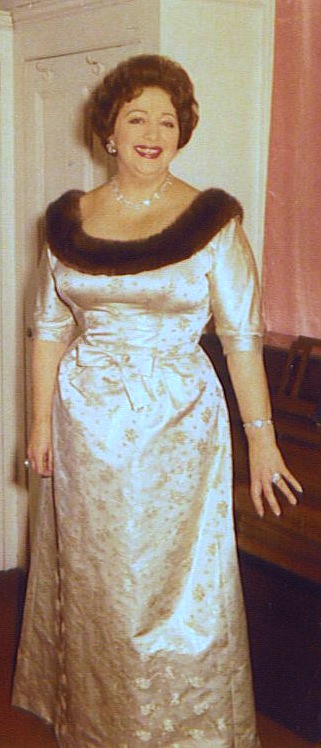
Happy Birthday: Zinka Milanov
Zinka Milanov was born May 17, 1906, as Zinka Kunc in Zagreb, Croatia. She studied with the Wagnerian soprano Milka Ternina and her assistant Marija Kostrenčić. She also studied in Milan with Campi and in Vienna with Stickgolt. On October 29, 1927, she made her operatic debut as Leonora in Giuseppe Verdi's Il Trovatore in Ljubljana, Slovenia, at the young age of 21. Her debut in her native Croatia, at the National Theatre in Zagreb, took place five weeks later as Marguerite in Charles Gounod's Faust. After an early debut in Dresden (November 5, 1928, also as Leonora), her teacher, Ternina, was not pleased and much work commenced to perfect her technique. She performed in Zagreb and Ljubljana almost exclusively for the next six years. Later she became a member of the New German Theatre in Prague, where all performances were sung in German. She was discovered there by Bruno Walter,
who recommended her to Arturo Toscanini for a performance of Verdi's Requiem in Salzburg. In 1937, the soprano made her debut at the Metropolitan Opera, once again as Leonora. At that time she adopted the name Milanov, which was the stage name of her second husband, an actor. According to Milanov herself, "Kunc" wasn't "glamorous" enough for the Metropolitan Opera. In the article "Zinka Takes Off" (Opera News, November 2004, vol 69, no. 5), it is stated that the name change was deemed necessary since the gentlemen at the Met feared the "implications inherent in what they predicted would be the standard American mispronunciation — but they were never forthright with her about it". On November 8, 1937, Erich Simon, who was in charge of engaging Milanov, cabled Edward Ziegler, the assistant manager of the Met, "Mme Zinka KUNZ-MARCOVIC has informed me that she wishes to perform under her husband's stage name,
MILANOV." In 1947, she left the Met when she married, for the third time, Yugoslav general and diplomat Ljubomir Ilić, and returned to live in Croatia. She was at the peak of her artistic and vocal powers when she made her debut at the Teatro alla Scala as Tosca in 1950. Milanov returned to the Metropolitan Opera the same year, invited by Rudolf Bing in his first year there as general manager. She gave her final performance in 1966 at the closing night of the old Metropolitan Opera House. Having worked as a voice teacher while still performing, Milanov devoted herself to teaching after her retirement. Among her pupils were Betty Allen, Grace Bumbry, Christa Ludwig, Regina Resnik, Dubravka Zubovic and Milka Stojanovic. She recorded prolifically from the 1940s through to the 1960s. Her voice was well-suited to Italian operas such as those of Verdi, Ponchielli, Puccini and the verismo composers. She died in New York City, aged 83. [Source]
who recommended her to Arturo Toscanini for a performance of Verdi's Requiem in Salzburg. In 1937, the soprano made her debut at the Metropolitan Opera, once again as Leonora. At that time she adopted the name Milanov, which was the stage name of her second husband, an actor. According to Milanov herself, "Kunc" wasn't "glamorous" enough for the Metropolitan Opera. In the article "Zinka Takes Off" (Opera News, November 2004, vol 69, no. 5), it is stated that the name change was deemed necessary since the gentlemen at the Met feared the "implications inherent in what they predicted would be the standard American mispronunciation — but they were never forthright with her about it". On November 8, 1937, Erich Simon, who was in charge of engaging Milanov, cabled Edward Ziegler, the assistant manager of the Met, "Mme Zinka KUNZ-MARCOVIC has informed me that she wishes to perform under her husband's stage name,
MILANOV." In 1947, she left the Met when she married, for the third time, Yugoslav general and diplomat Ljubomir Ilić, and returned to live in Croatia. She was at the peak of her artistic and vocal powers when she made her debut at the Teatro alla Scala as Tosca in 1950. Milanov returned to the Metropolitan Opera the same year, invited by Rudolf Bing in his first year there as general manager. She gave her final performance in 1966 at the closing night of the old Metropolitan Opera House. Having worked as a voice teacher while still performing, Milanov devoted herself to teaching after her retirement. Among her pupils were Betty Allen, Grace Bumbry, Christa Ludwig, Regina Resnik, Dubravka Zubovic and Milka Stojanovic. She recorded prolifically from the 1940s through to the 1960s. Her voice was well-suited to Italian operas such as those of Verdi, Ponchielli, Puccini and the verismo composers. She died in New York City, aged 83. [Source]
"Domovini I Ljubavi" traditional song
"Ernani, involami" Ernani
![]() | ![]() | ![]() |
"Un bel di vedremo" Madama Butterfly
"Ecco l'orrido campo" Un Ballo in Maschera
![]() | ![]() | ![]() |
"Ritorna vincitor" Aida
"Suicidio" La Gioconda
![]() | ![]() | ![]() |
"D'amor sull'ali rosee" Il Trovatore
"Měsíčku na nebi hlubokém" Rusalka
Happy Birthday: Birgit Nilsson
![]() |
| La Nilsson singing Wagner's Isolde at the MET Gala 1983 |
![]() |
| With her dog Nalle in Sweden |
![]() |
| Bing Gala at the MET 1972 |
"Starke Scheite, schichtet mir dort" Götterdämmerung
"La fatal pietra..." Aida (w/Luigi Ottolini & Grace Hoffman)
"Dich teure halle" Tannhäuser
"Mario, mario, mario!" Tosca (w/Franco Corelli)
"Der Engel" Wesendonck Lieder
"Ah! Perfido"
"Una macchia" Macbeth
"O Don fatale" Don Carlo
"Du wolltest mich nicht deinen Mund küssen lassen" Salome
"Crudele!...Non mi dir" Don Giovanni
A full biography and funny anecdotes are after the jump.
Subscribe to:
Posts (Atom)